
External Validation of Predictors of Mortality in Polytrauma Patients
- Population
- Adult Level I trauma activations
- Evidence
- Retrospective external validation
- Next milestone
- Prospective workflow evaluation
Clinical intelligence to help care teams understand a patient’s changing condition and hospital leaders improve care across the service line.
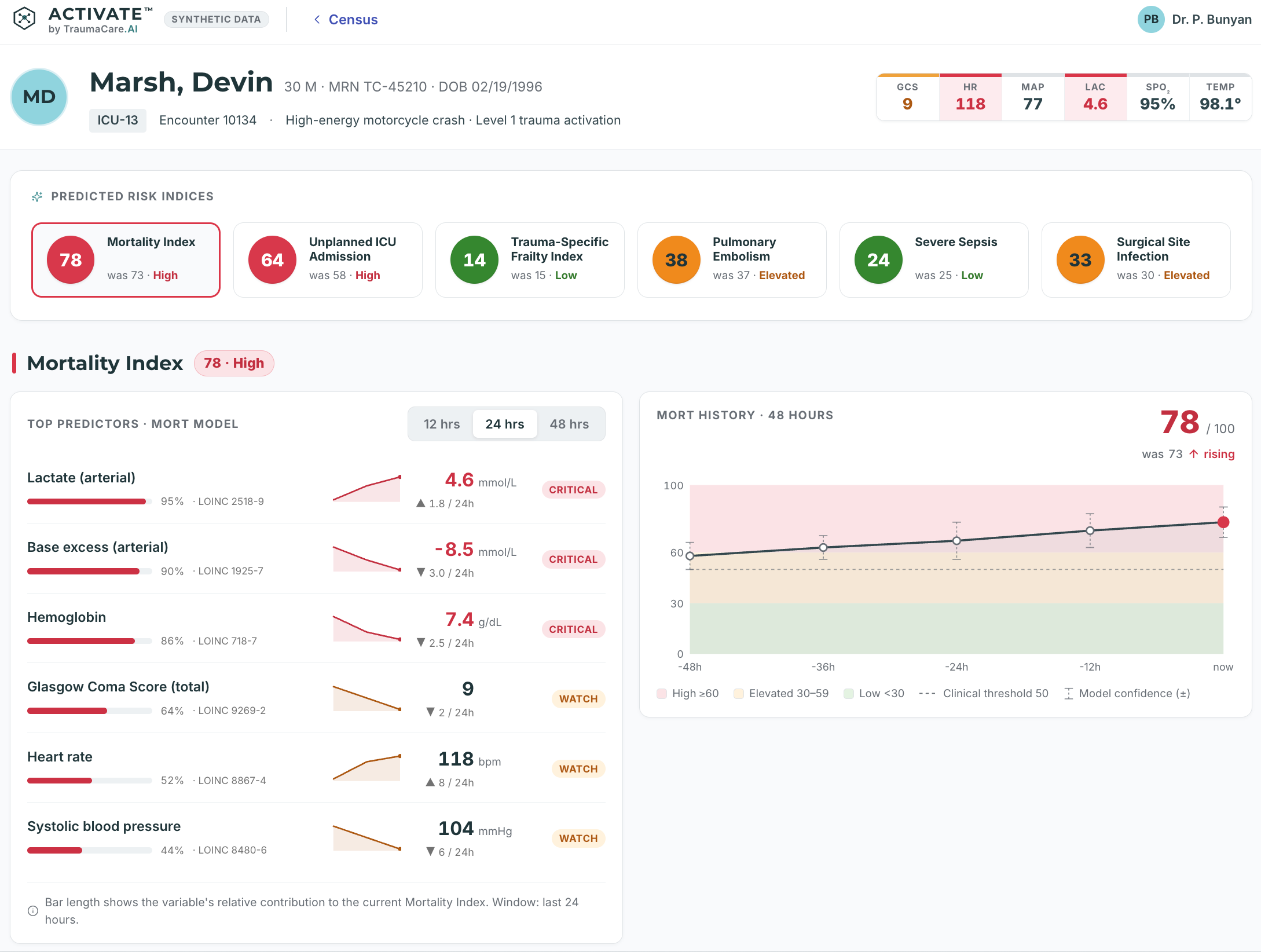
ACTIVATE is our EHR-integrated clinical intelligence platform for trauma and critical care. It brings the patient’s changing risk and clinical context into the workflow, so care teams can follow each patient’s course over time.
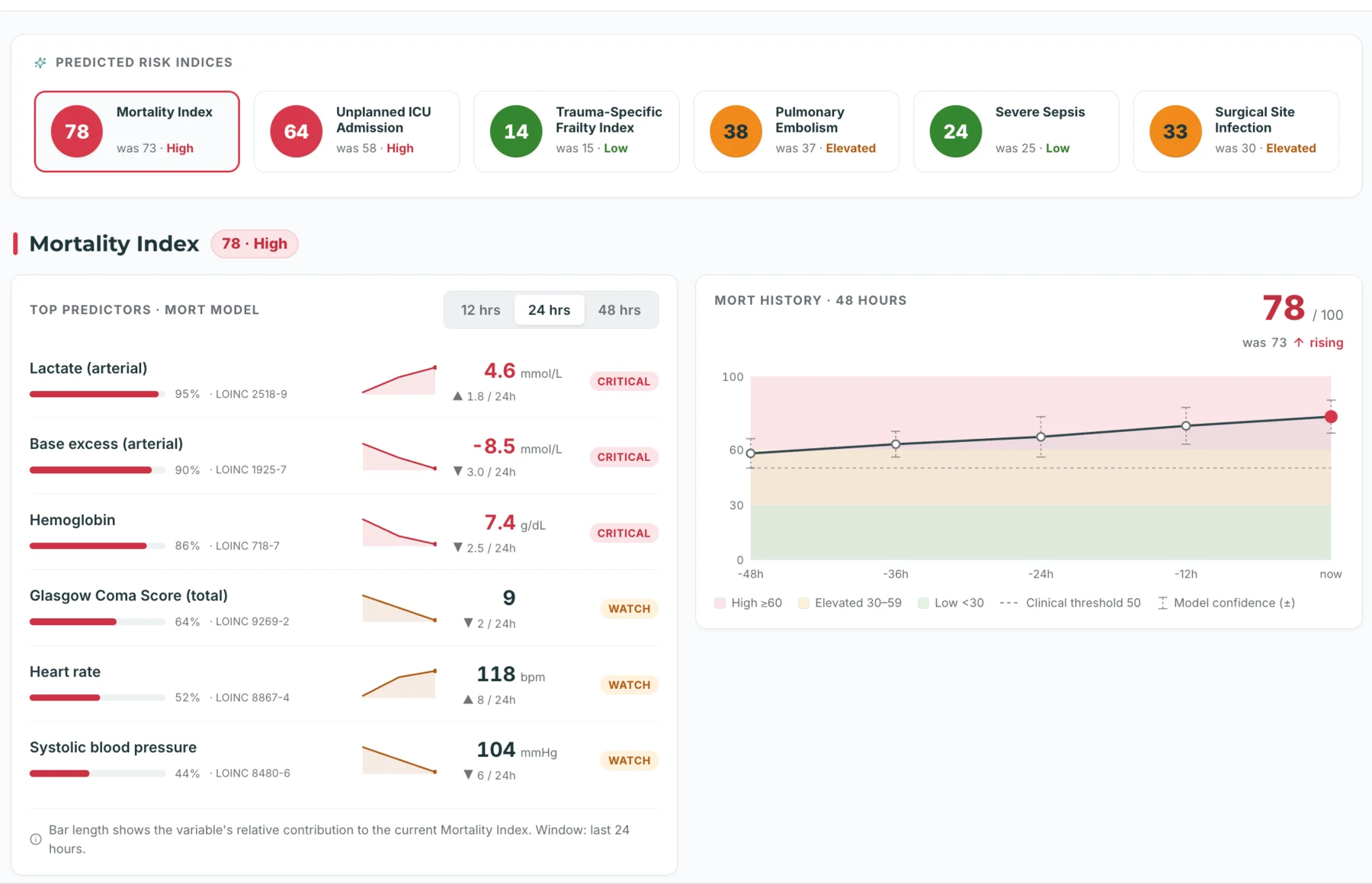
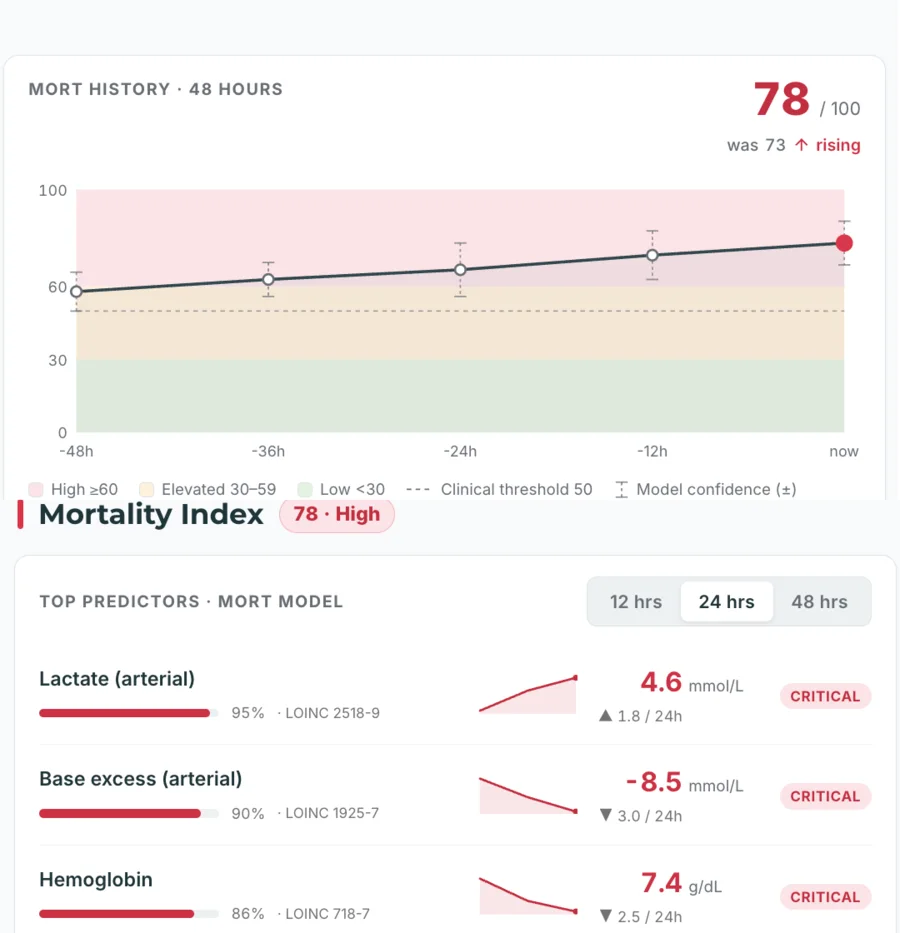
Behind every changing signal is a patient whose story is still unfolding. ACTIVATE helps care teams see where that story is headed.
How is the patient changing?
What is shaping that change?
What does the care team need to see together?
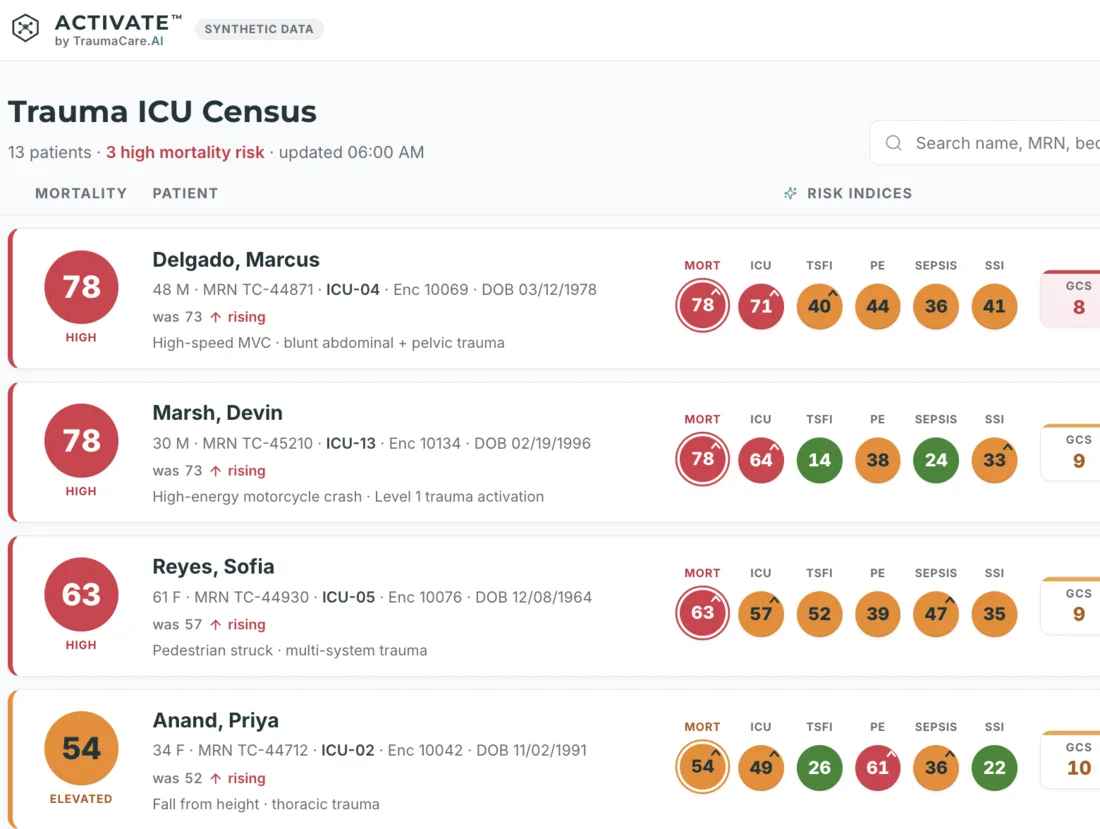
ACTIVATE brings patient context and risk trajectories into EHR workflows.
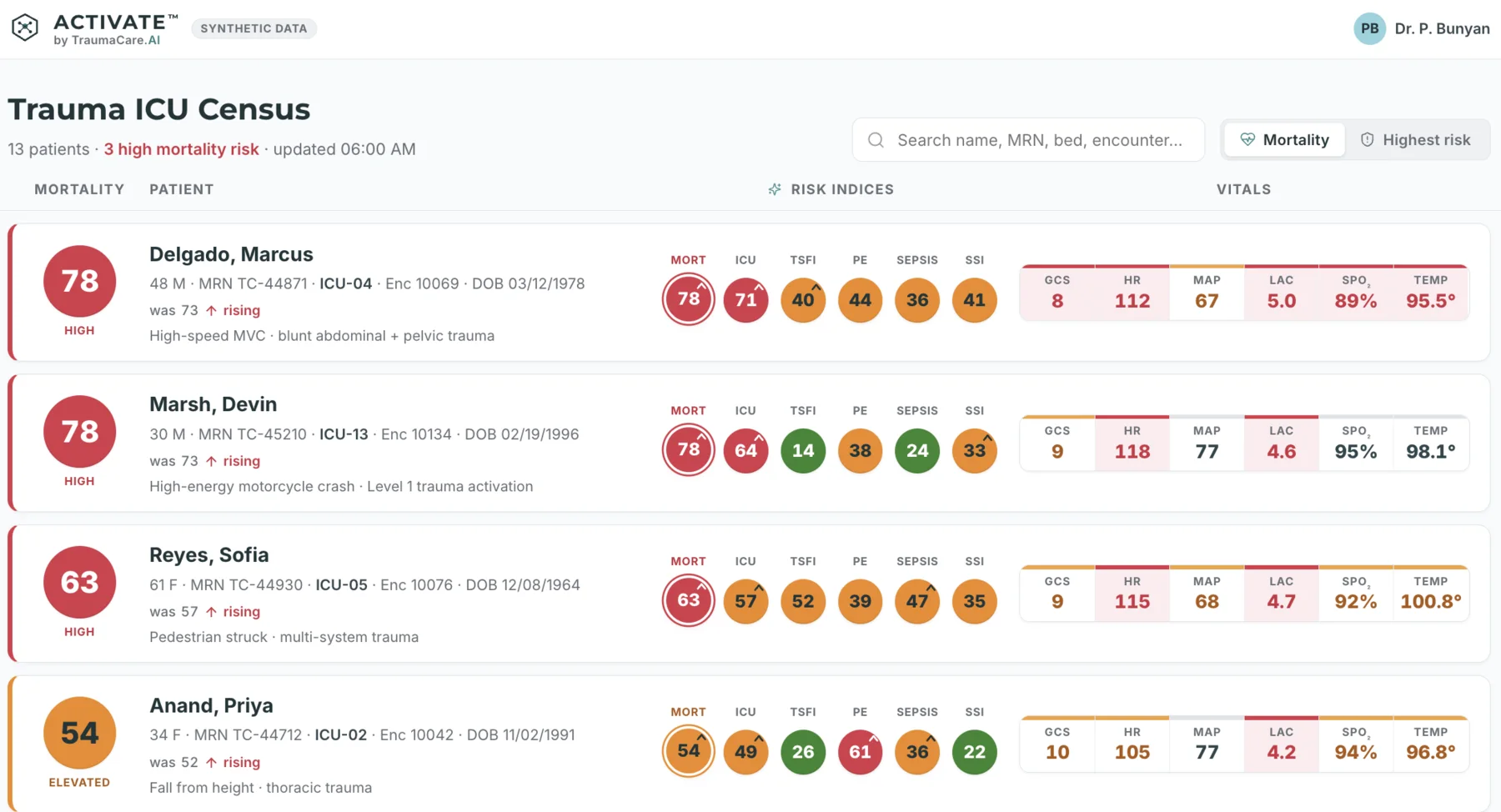
Care teams can examine an individual patient’s course and review changing signals across the unit.
Published trauma research provides the starting point. Additional critical-care capabilities are in development around the same shared patient view.
As additional capabilities are validated, they should help teams investigate more aspects of the patient’s course within the same clinical workflow. Hospitals can build on their experience with ACTIVATE as they address additional critical-care needs.
Review our published trauma researchTrauma mortality
Unplanned ICU admission, trauma-specific frailty, pulmonary embolism, severe sepsis, and surgical-site infection.
Planned for ACTIVATE
Understanding a patient means knowing which details matter as their condition changes.
We are developing ACTIVATE to bring the patient’s evolving story into view and help the team investigate what deserves attention. Trauma and critical-care expertise shapes which details come forward and which questions remain unresolved.
The aim is to help the team examine the patient’s course with the relevant evidence in front of them.
Once ACTIVATE is connected to your EHR, new clinical capabilities can build on that same integration.
Our team develops those capabilities around critical-care workflows, with clinicians guiding their fit for local use.
ACTIVATE provides the bedside foundation. Our planned quality intelligence product extends learning across patients.
Introduce a locally evaluated capability into clinical use.
Add capabilities through the existing clinical data connection.
Let clinical questions and reviewed findings shape what comes next.
For clinical and operational leaders across the critical-care service line.
Some questions begin with one patient and lead to many others.
When a patient returns unexpectedly to intensive care, leaders need to understand what preceded that return. They also need to know whether similar patients are following a similar course, and what that suggests about their care.
Teams must reconstruct encounters and compare patient groups. Daily demands can leave little time for that investigation.
Our planned quality intelligence product extends this perspective across the critical-care service line. Built on the clinical data foundation established through ACTIVATE, it will help leaders investigate questions across patients and surface emerging patterns for review.
The purpose is to help clinical leaders decide what to change in care, then examine whether those changes are helping.
Our clinical collaborators help identify important problems and evaluate whether new capabilities are useful in practice. Their work informs what we develop next and the evidence needed before clinical use.
Our published research begins in trauma. We are building on that foundation as ACTIVATE expands toward broader critical care.
Meet the people behind ACTIVATEACTIVATE supports evaluation with your hospital’s data before a model enters clinical use.
Clinical and governance leaders guide its introduction and review its performance over time.
Map relevant EHR data already captured in clinical workflows.
Evaluate model performance on relevant local patient populations.
Assess model behavior and workflow fit through silent evaluation.
Configure access and presentation with clinical and governance leaders.
Monitor performance and document changes and review decisions over time.
Health systems can also use this process to evaluate and govern models they develop or select.
TraumaCare.AI co-authored a 2024 Journal of Surgical Research study of mortality predictors in approximately 5,000 adult Level I trauma activations at the University of Cincinnati.
The study externally evaluated previously published predictors and developed an institution-specific model using local data. That retrospective work provides the evidence foundation from which ACTIVATE’s trauma mortality capability has evolved.
It does not establish prospective clinical impact or validation across broader critical-care populations.
Tell us about the clinical questions your care teams face, or the patterns your service-line leaders need to understand.
Explore ACTIVATE for bedside clinical intelligence, or discuss the quality investigations your organization needs better tools to pursue.
Please do not include patient information.